
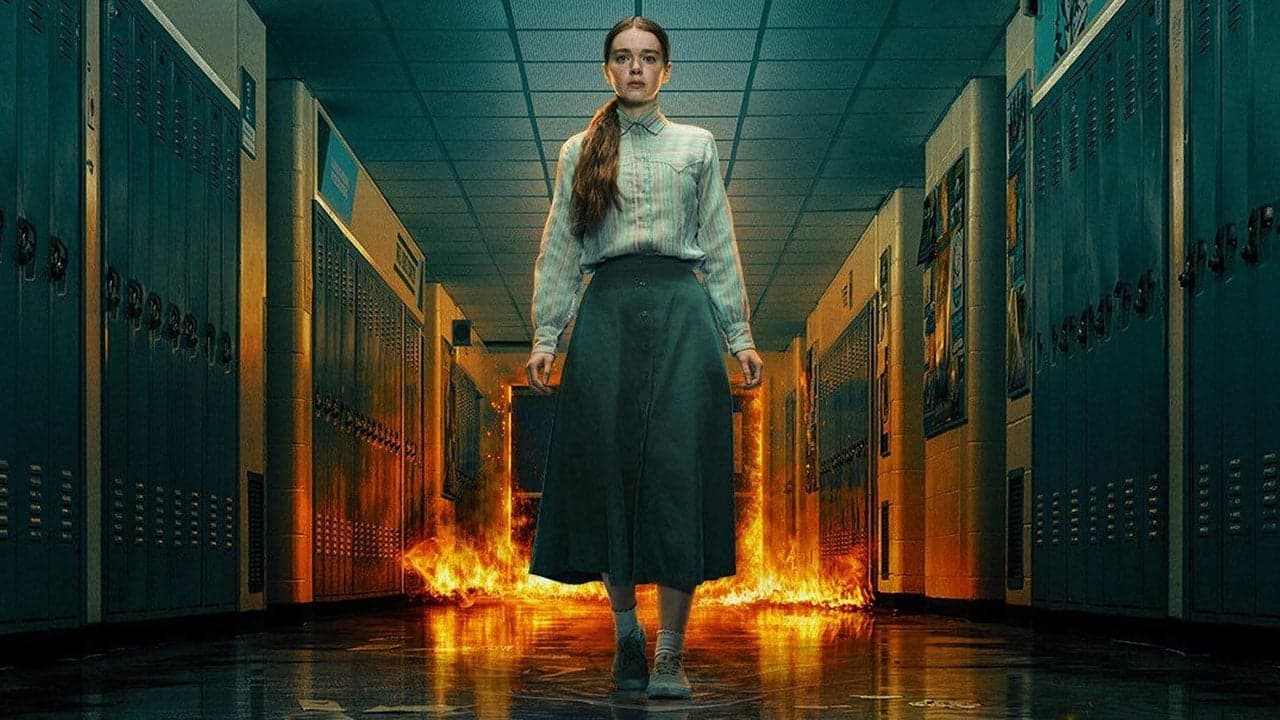
Carrie debuts on Prime Video on October 7. This is a spoiler-free review.
It’s easy to forget that for all the haunted hotels, dark towers, cursed cemeteries, society-ending viruses, killer clowns, and various and sundry things that go bump in the night that Stephen King has subjected us to, the author’s half-century grip on the horror genre started with a telekinetic teenage girl named Carrie White. Carrie’s cautionary tale of bullying has been adapted and sequelized numerous times, and Kimberly Peirce’s 2013 film even beat Mike Flanagan to the punch by first pulling Carrie into the 21st century. But, as is often the case when Flanagan brings King to the screen, Carrie successfully celebrates what makes the novel so relevant 52 years after its first publication by evolving with the times and palpably deepening King’s characters.
The opening moments of the premiere treat Carrie’s story with a Shakespearean level of reverence, with a Greek chorus of doc-style talking heads giving an overview of the story’s well-known beats that led to that fateful prom night. Inviting a closer look at all angles of that story is the dramatic thrust of Carrie, and the series sets itself up well for that effort by structuring itself as a teen drama in the vein of Pretty Little Liars or Riverdale. Carrie is an epistolary novel which heavily relies on interviews with the survivors of the prom night massacre and documentary evidence to tell Carrie’s story, and the series replicates that fractured perspective of the events by quickly setting up different groups of characters tied to Carrie as focal points for the narrative to jump around to.
Flanagan and his team are broadly successful in adapting the story and themes already present in King’s novel to the teen drama format. Carrie’s not a plot-heavy book, and the series compensates for that by spending more time on exploring how everyone is processing the events as they play out, and how the evolving interpersonal and public relations crises are picking at scabs at the back of the minds of characters like Carrie’s teacher Rita Desjardin (Amber Midthunder) and Principal Grayle (Matthew Lillard). The extra time and scope afforded to the story is a rising tide that lifts all boats, even if that format does occasionally leave room for some overwrought stylistic or dramatic choices. There are a few too many on-the-nose dream pop needle drops with lyrics that explain what the action of a given scene has already communicated just fine.
اقتباسی موفق از دنیای استیفن کینگ
Flanagan and his team are broadly successful in adapting the story and themes already present in King’s novel to the teen drama format.
Carrie is not one of Stephen King’s strongest characters on the page - that epistolary style of the novel leaves Carrie often feeling a little decentralized from her own story - but that problem doesn’t persist into the TV series. The Carrie series is unquestionably successful in its most important effort: putting the plight of its two central characters, Carrie and Margaret White, into a modern context. As Carrie, Summer H. Howell is totally magnetic from her first moments onscreen. Carrie’s wide-eyed enthusiasm for integrating with the outside world is contagious, even as her first day with classmates like good-natured Sue Snell (Siena Agudong) and mean girl Chris Hargensen (Alison Thornton) proves to be overwhelming. Howell’s accommodating and empathetic energy, even in the face of how poorly Carrie’s treated by the world, is a well of positivity and light that Flanagan and his team of directors - Kate Siegel, Axelle Carolyn, Kyra Sedgwick and Hiromi Kamata - continually put to the test across not just the classic challenges from her story, but the new ones afforded by the present-day setting. As Carrie becomes more self-assertive and is then tempted towards darkness, Howell’s work is even more impressive, and the writing does a good job giving her the space to take Carrie down more intense lanes without losing sight of the precocious girl she is at heart.
Carrie getting pelted with tampons in the shower by a gang of girls led by Regina George Chris Hargensen while she gets her first period is bad enough, but the show follows that event to its next logical permutation in 2026: what happens when video of that kind of horrific bullying makes its way onto social media in the form of a meme account run by Chris, “CarrieRed.” The viral spread of the “CarrieRed” account, and the resulting fallout, is a reliable kettle the show keeps on the boil throughout the season. With that in mind, despite its supernatural trappings, much of the show’s horror is internal and existential. There are surely scares, but by and large, Carrie is content to let the experience of being a teenage girl be its own engine of horror.
Of course, Carrie’s reaction to being so callously treated by people she just wanted to be friends with is paramount, but the show takes pains to keep Sue and Chris’s experiences of these in focus as the two social poles between which Carrie is being pulled. Both Siena Agudong and Alison Thornton are good in their roles, but with Sue being a naturally decent person who usually makes the right decision, it’s Thornton’s volatile Chris that winds up with more exciting material, especially given how Flanagan and company use her own complicated circumstances at home to serve as a foil to Carrie’s. Chris’ life is falling apart, with an estranged mom and a jerk father whose poor planning leaves her freshman year of college in jeopardy, and despite the fathomless cruelty that Chris inflicts on Carrie, the writing finds grace for Chris by making clear that there are plenty of ways that poor parenting can leave a girl ill-equipped to navigate the trials of growing up in 2026.
بررسی شخصیتپردازی و تحولات داستانی
Carrie’s relationship to the events of the plot are largely unchanged from the novel, so it’s Samantha Sloyan’s Margaret White, Carrie’s mother, who winds up as the character with the most worthwhile overhaul here. Margaret White is one of the most famous religious zealots of horror fiction, but this series explores the roots of that fundamentalism in a much more nuanced way, a mission statement the series makes right off the bat with a canny alteration to the book’s inciting incident.
The death of Ralph White, Margaret’s husband, still leads to the authorities discovering Carrie’s shut-in conditions back at home but, this time, the cops discover both Carrie and Margaret holed up in the family prayer closet, where sinners in this house are sent to repent. The way Ralph looms as a specter over their home even after his death makes it clear as the season continues that Margaret’s fervent attempts at protecting her daughter from the outside world are rooted in the ways her relationship to her ultra-right wing husband warped her own worldview. Margaret sees herself as a holy warrior, and is there no more ungodly battlefield in that war than the town square of social media, especially with her daughter being savaged there on a daily basis?
Samantha Sloyan, a frequent Flanagan collaborator, is perfectly cast as Margaret, with the actress’s intensity and openness each a perfect fit for the character’s megalomania and genuine love for Carrie. Sloyan is at her best taking that holy warrior energy toe-to-toe with those she sees as adversaries at the school, like Principal Grayle, who are mostly doing their best to balance doing right by Carrie with the institutional loopholes that leave them hamstrung in those efforts. How willing others in the town of Chamberlain seem to be to cosign Margaret’s style of guardianship call attention to her pridefulness in ways that don’t let her off the hook from being responsible for her choices, but do wonders for pointing out how prevalent the tendency to be “holier than thou” really is these days.
What shakiness is present in how Carrie is expanded out to eight episodes of TV comes from a side plot and characters that Flanagan and the writers have created to underline Carrie’s significance to the wider Kingverse. Their presence does at least make sense, given how freely the Carrie novel acknowledges the presence of other characters with the “TK gene” out in the world. Flanagan uses one character in particular to give structure to each episode, most beginning with her narration about the story of another gifted girl or woman out in the world. It’s during these vignettes that the series’ writing is at its least subtle, lacking enough variety in how they speak to the way Carrie represents all disenfranchised women to keep them from feeling a little repetitious by the season’s end.
The varying mileage these additional plot elements get is perhaps best represented in the presence of another brand-new character, Emaline (Thalia Dudek). Emaline is another new student at Ewen High who befriends Carrie and encourages her to take a more active stance against her antagonists but, as written, Emaline’s function in the story winds up being a little too one-note for a little too long to feel like a necessary invention. The Carrie series folds in this supporting roster of characters sparingly, but their presence does call for the show’s focus to occasionally drift, especially as things start heating up going into the finale.
منبع: ign.com